
What is Digital vs Analog
What does it mean to be digital? In a broad answer, we can say that using electronic devices to communicate with information and people is being digital. A company changing their practices by utilizing computer programs to streamline efficiency and update their business model is a good example of becoming digital. An entire business process that is fully automated from front end to back end without any need for human interaction captures the essence of being fully digital.
But what actually is the concept of digital electronics? How do they work?
The real world around us is fully analog. Every signal from audio signals like our voice, to electricity, to any measurement is analog or continuous. Human made electronic devices are not capable of handling continuous signals however. Digital electronics operate with bits, binary numbers of 1’s and 0’s that are stored in the hundreds of thousands and the millions. Lets take an audio signal for example, my continuous voice signal comes into a microphone, if I want to send this voice recording somewhere remotely. The signal needs to be sampled into discrete digital values at a very fast rate. Instead of a signal being recorded in time (t), we have a signal recorded in indexes (n). That is what a digital system can store, memorize, and transfer data to another location. Once transferred, the signal becomes reconstructed to a continuous analog signal to be output to its destination. This process falls under the wide topic of DSP or Digital Signal Processing, and more specifically, ADC or Analog to Digital Conversion.
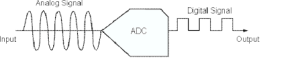
Becoming digital for buisness inherently requires a brief transfer from the analog language to the digital language, and then back in to the analog world. This process is how businesses and the world can bypass human interaction and become fully encompassed in the digital world.
– Griffin Hebert